June 24, 2010
Bunny Chow and Buttermilk Rusks
8 comments     Categories: Cook and Eat, Food, Lunch, Recipe, Savory, Travel

What better mementos could you bring home from a trip than a handful of new recipes? They don’t take up space in your suitcase, and you’ll have them for years and years to come.

From South Africa, I came home with more than a couple of recipes, but I’ve been very eager to share these two with you. Of course, arriving home after two weeks away meant that things got very busy, but this week has pleasantly returned to a more leisurely pace. Time for cooking and shooting and sharing.

First off, when we were in Durban, it was all about the Bunny Chow, a hearty dish of knock-your-socks-off curry that is served in a bread bowl that is a half loaf of bread. Bunny chow doesn’t have anything to do with rabbits, but rather the dishes Indian heritage, from a vegetarian immigrant group known as the Bania. The original vegetarian curry was served up in a loaf of bread, which allowed it to easily be transported to eat in the streets, at work or wherever (depending on whose history you believe). Over the years, the curry has changed and is more often a lamb or mutton curry made with a very spicy red curry spice. But it’s still eaten without utensils, using the bread to scoop out bites of the curry.

The day after the race, Cam and I stopped in to a cute cafe in Durban, Bean Bag Bohemia, to sample our first bunny chow, although there it was called Durban Stuff. And stuffed it was, with chicken and prawns and one of the spiciest curries I’ve ever had. Good thing there were also cocktails!

(more…)

June 17, 2010
Lions and Tigers and Bunnies, Oh My
12 comments     Categories: Cook and Eat, Travel

Ok. There weren’t any tigers. But there were certainly lions, elephants, cape buffalo, cheetahs, vultures, white rhinos, ostriches, crocodiles, hippos, wildebeasts, zebras, giraffes, wild dogs, hyenas, impala, water bucks, elans, warthogs, black eagles, jackals and more. And, perhaps more importantly, there were bunnies. But I’ll get to those later.

Let me just start out by saying South Africa is a fantastic place, and I don’t think I’ve ever traveled to a spot with friendlier, happier people. Everyone was excited… for the race, for the World Cup, for the beach, or just to be there doing whatever it is they were doing. Our flights out were incredibly uneventful, and even downright easy given we had a 9 1/2 hour flight from Seattle to Amsterdam followed almost immediately by a 10 1/2 hour flight to Johannesburg. A quick night at an airport hotel, and the next morning we were off to Durban, which would be our home base for Comrades.

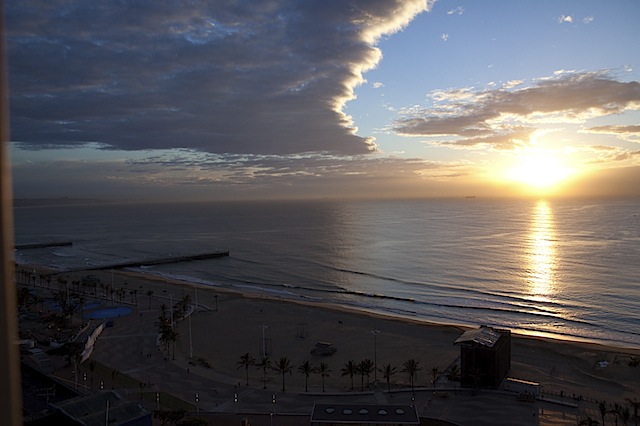
sunrise over durban

One of the benefits of jet lag: I don’t think I’ve ever seen so many sunrises in 12 days…


Durban is a located on a beautiful beach, although the day we arrived it was hard to tell because of the extreme winds. Apparently, every year they have a crazy storm day that marks the switch over between summer and winter… and that was it. Luckily, the next morning we woke to a beautiful temperate day (cool by the local standards, but quite a bit like an early summer day here in Seattle) which was typical of the weather the rest of the trip.

Race day was on Sunday, and Cam and his friend Randy both did a great job. Cam even beat his goal time by a few minutes, which is incredible for such a crazy race paired with jet lag. Needless to say, after running 55 miles, the boys were pretty wiped for a few days, so we had a lazy day before heading back to Johannesburg to catch our shuttle up to Kruger park for a quick safari.

southafrica-13.jpgsouthafrica-18.jpg

southafrica-39.jpg  

southafrica-88.jpgsouthafrica-57.jpg

southafrica-96.jpgsouthafrica-87.jpg

southafrica-79.jpg

Our safari took us both into Kruger National Park (for a full, 10 hour drive) and to a private game reserve for 2 evening game drives (we booked through Intrepid and they managed everything beautifully). In case you can’t tell from the photos, you do get incredibly close to some of the animals.

southafrica-124.jpgsouthafrica-131.jpg

southafrica-139.jpg

southafrica-28-1.jpgsouthafrica-35-2.jpg

southafrica-144.jpg

southafrica-153.jpgsouthafrica-49-1.jpg

southafrica-57-1.jpg
southafrica-138-1.jpg
southafrica-175.jpgsouthafrica-176.jpg
southafrica-184.jpg
southafrica-17-2.jpg

southafrica-52-2.jpgsouthafrica-56-2.jpg

southafrica-89-2.jpgsouthafrica-91-2.jpg

southafrica-197.jpg

We also had the privedge of visiting the Moholoholo Rehabilitation Center which helps injured, abandoned or problem wildlife. The fact is that throughout Africa, the loss of natural habitat for animals is stunning. Parks like Kruger help preserve some habitat, but it is far too little for most animals, and there is a huge threat to the ecological balance. Moholoholo doesn’t have all the answers, but is doing what it can to help raise awareness of how precious the wildlife and habitat are to the continent. At the center, most of the animals they take in are treated and released back into the wild, but there are a good couple of dozen animals that have been socialized with people (although still quite dangerous) and act as ambassadors for their species, including much to our luck two 10 week old cheetahs which we were able to “help” socialize by petting.

southafrica-255.jpgsouthafrica-260.jpg

southafrica-204.jpgsouthafrica-220.jpg

southafrica-216.jpg

The hyena was in love with Cam.

southafrica-278.jpgsouthafrica-283.jpg

We got to feed the vultures…

southafrica-3-2.jpgsouthafrica-11-2.jpg

…but feeding the lions is best left to the professionals.


This trip wasn’t much about food… the guys needed to keep it mild and carby before the race and the safari meals were tasty but definitely tourist “safe” (emergency bathroom breaks in the bush aren’t necessarily a good idea!) But, I did manage to pick up a handful of great looking South African cooking magazines, and have been very inspired by what I’ve found.

autoimport-3490.jpgautoimport-3491.jpg

I can’t wait to go back, next time to sample more of the food & wine. In the meantime, I’m happy to indulge in buttermilk rusks, milk tart and one of my new favorites: bunny chow!

Have you ever had bunny chow (if you are cool, you just call them bunnies… but I love saying bunny chow!)? Or are you just as curious as I was when I was in Durban trying to hazard a guess as to what it might be?

December 9, 2008
On Guadeloupe and Martinique
Add your comment     Categories: Food, Lunch, Recipe, Savory, Side, Travel

Some time ago, Cam switched from being a mostly scotch drinker to a mostly rum drinker. I’m not talking Captian Morgan’s here. Aged rums, particularly those from the Caribbean and even more particularly those from Martinique, are fine sipping rums that, at least in our opinion, rival high-end whiskeys. The only problem is that they are very hard to get, particularly in Washington state. So, for Cam’s Christmas present last year, I decided it would be fun to take a trip down to Martinique to visit some of his favorite distilleries. Back in October, we finally made it on the trip. I can’t quite believe that it has taken me this long to get to the photos so I could share them here. But, I suppose that if it took us 9 months to actually fit the trip into our schedule, a month or so to polish up the photos isn’t bad.

It’s not exactly high season on these islands at the end of October. The beaches were quiet, restaurants had seating (if they were open… unfortunately a big if for some places), and the weather has started to mellow (still warm but fewer chances of hurricanes). It’s a great time to visit if you aren’t looking for a big party. On Martinique, we were the only guests in the gorgeous plantation Inn, Le Domaine St Aubin with only a few more guests in the quaint and lovely Le Diwalli on Guadeloupe. We spent our time lazing around on the beaches under palm trees, driving around the islands to see some of the local culture, and mostly, eating and sampling the local rum (we made it to Clemant, JM Rhum, Neisson, St. James, and Damoiseau).

I have so many photos to share, but I think 200 would be a few too many for this post!


 Mg 1929-5 Mg 1932-9
 Mg 1935-12 Mg 1936-13
 Mg 1941-17 Mg 1945-20

We arrive in Guadeloupe, after about 16 hours of travel overnight. Seattle to Miami, Miami to Haiti, Haiti to Guadeloupe. After a bit of a confusion trying to figure our way out of the airport, we arrive at the hotel and take a short wander down the beach to grab some lunch… crepes & sandwich, with of course, two Carib.

 Mg 1950-24 Mg 1958-30
 Mg 2012-83 Mg 2022-93
 Mg 2041-112 Mg 2057-128
 Mg 2061-132 Mg 2069-140
 Mg 2087-158 Mg 2099-168
 Mg 2107-176 Mg 2114-183

The botanical gardens on Guadeloupe are definitely not to be missed. Particularly, if you don’t mind being covered with birds.

 Mg 2129-198 Mg 2136-205
 Mg 2124-193
 Mg 2139-208 Mg 2145-214

After the gardens, we tried to have dinner in Deshales, but it had been fairly badly hit in the hurricane that came through the week before. Most of the restaurants were under repair or just closed for the down season. So, we grabbed a quick bite at the small convenience store, and sat and watched the sunset.

 Mg 2148-217

One of my favorite things about Guadeloupe is that there are cows, everywhere. In fact, immediately after leaving the airport, one of the first things I saw (even before we made it to the rental car place) was a cow grazing on the median of the highway. Everyone seems to have a cow. Or rather a steer or a bull. I didn’t see any girl-cows the entire time we were on the island.

 Mg 2165-234
 Mg 2170-239 Mg 2171-240

The tasting room and shop at Damoiseau was very friendly, and let us have a “ti” (little) sip of whatever we’d like. In addition to sipping rums, they make a selection of flavored rums. We found that our favorite was “Shrub” which is an orange scented rum similar to Grand Marnier. Perfect over ice cream, if you find yourself with a bottle.

 Mg 2175-244 Mg 2178-247
 Mg 2186-255
 Mg 2189-258 Mg 2191-260
 Mg 2210-279
 Mg 2198-267 Mg 2233-302

Quiet beaches were everywhere in Guadeloupe in October.

 Mg 2246-312 Mg 2257-322
 Mg 2261-326 Mg 2262-327
 Mg 2266-1 Mg 2271-6

Dinner and then breakfast at Le Diwalli.

 Mg 2273-8 Mg 2281-16
 Mg 2279-14 Mg 2282-17
 Mg 2284-19 Mg 1944-19


I thought the cats were perhaps after my salad niciose at this beachside cafe, but they really just wanted attention.

 Mg 2290-25
 Mg 2358-93

One last sunset for us on Guadeloupe… then we are off to Martinique.

 Mg 2370-2

Sugar cane fields back to banana plantations all over Martinique.

 Mg 2377-9 Mg 2375-7
 Mg 2379-11 Mg 2382-14
 Mg 2391-23
 Mg 2387-19 Mg 2394-26
 Mg 2401-33
 Mg 2417-49 Mg 2419-51
 Mg 2421-53 Mg 2424-56
 Mg 2407-39


The Clemant Distillary has a fantastic botanical gardens and museum that shows how rum is made. Definitely one of the nicest exhibits we saw.

 Mg 2432-64
 Mg 2435-66
 Mg 2460-92
 Mg 2487-119
 Mg 2490-122
 Mg 2513-145
 Mg 2494-126
 Mg 2502-134 Mg 2525-157

The afternoon at Anse des Salines.

 Mg 2536-168 Mg 2539-171
 Mg 2538-170


We took a full day tour of some of the islands off the coast of Martinique, including a stop at “iguana island” where the trees are hiding some huge lizards which are only found on this one island. They warn you to be careful as sometimes they drop down on you. Eek. Other stops included some hanging out in Josephine’s Baths and doing a bit of snorkling.

 Mg 2543-175 Mg 2546-178
 Mg 2551-183 Mg 2558-190

Lunch at Le Ghetto, one of our favorite meals of the trip… ti punch (which is ironically named, since it’s really a huge punch to your head) which was self-service here with tasty Clement rhum, acras (salted cod fritters) and a whole, creole style poisson. Yum.

 Mg 2561-193 Mg 2566-198
 Mg 2571-203 Mg 2578-210
 Mg 2572-204

A stop into JM Rhum which was much smaller than the Clemant tour but just as tasty in the sampling room.

 Mg 2580-212 Mg 2584-216

The porch, right outside our hotel room on Martinique. We had quite the view as we sipped our punch plantuer and punch coco.

 Mg 2588-220

The next day, we were going to take a drive over to the other side of the island through the mountains. After quite a ways of driving, we learned what “route est barrée” meant. Yes, that is the road behind that puddle. No wonder there were no cars going the other way.

 Mg 2618-250
 Mg 2592-224 Mg 2604-236
 Mg 2585-217

We managed to find another route and took a quick stop into the Neisson distillary where we found yet another yummy rhum concotion… this one is a cacao rhum, which as it turns out, is fantastic when also mixed with the Shrub. We also stopped in for a meal in Fort de France (more acras!) and a bit of shopping. The next day, it was time to start our trip home.

Once we were back home, I remembered a piece I shot for Seattle magazine on bacalhau the Spanish salted cod, which is available at The Spanish Table in town. I picked up a little package this week to make my own acras and bring back a little of our trip, complete with a little ti punch.


20081209 6595-630820081209 6596-6309
20081209 6598-631120081209 6601-6314

There are tons of variations for making acras… some separate and beat the eggs for a lighter batter, some add baking powder. The recipe I went with did neither, but still made nice, light fritters. However, as soon as they cooled, they got a bit chewy… so the search is on to find a recipe that stays crisp longer (text time around, I’m going to try this one.). In the meantime though, if you are looking for an easy, tasty appetizer that’s a little different, give these a shot.

20081209 6603-6316

Acras

5 oz. sifted flour
Salt and pepper
2 t creole spice
2 eggs
6 T (100 ml) cooled scalded milk or equal parts water and milk
7 oz salted cod fillet
1 bay leaf
1 sprig of thyme
1 chile, of the heat-level of your choice, minced
oil for deep frying

In a medium sized bowl, mix together the flour, salt, pepper and creole spice. Make a small well in the center, and mix in the eggs, one at a time. Then, add the milk and mix until smooth. Cover the batter and let it rest on the counter for 1 hour.

While the batter is resting, rinsing the cod well. You may wish to let it sit in water, refrigerated, overnight to help remove more of the salt. Then, place the fillet in a pot, cover with water and add the bay leaf and thyme sprig. Poach for about 10 minutes. Remove from the heat and rinse. Take a fork and start to shred the fish into little, hair like pieces, removing any bones or skin as necessary. You want the cod to be quite thinly shredded (but don’t use a blender… you don’t want paste).

Start to prepare your oil for frying. I used my deep fryer, but you can also use a deep pot with about 1 to 2 inches of oil.

Once the oil is hot, stir the shredded fish and minced chile into the batter. Take one teaspoon of the batter and drop it into the oil. Do this a few more times, but don’t overfill your pan or the oil will cool down too much. Let each fritter cook on one side for about a minute, and then flip it over to brown on the other side. When it is golden brown, remove it from the oil and place on a paper towel to drain.

Serve immediately. I like them with some chipotle mayonaise or a little tomatillo salsa and a squeeze of lime or lemon.

October 19, 2008
Two Tacos Please
Add your comment     Categories: About Me, Food, Lunch, Other, Seattle Restaurants, Travel

There has been a scheme in the works for some time now to have a day devoted to tacos. We’ve (Cam and I) been sampling various trucks and busses one by one for the past year, but never on a particularly organized basis and it became too hard to decide which one was really the best. Memories quickly fade, and we just end up with vague recollections of what we did or didn’t like. This would not do. We needed hard data to compare and contrast all the tacoy goodness. So, we decided that we’d pick a beautiful sunny day, and just drive around, trying tacos at the various Seattle taco trucks, to try to decide on an ultimate winner of Seattle’s Best Taco. Saturday, October 11th turned out to be that day.

After a morning of planning to find all of the taco trucks online that I could, and organizing a set of directions to most efficiently get us from spot to spot, we picked our targets and headed out. Of the 27 trucks I plotted, we’d try to go to 8 or 9 of them, ordering one carne asada and one al pastor taco at each, and splitting each of them. We were allowed sides but given the number of stops we had ahead of us, we were just going to stick to the two taco rule, at least until the end of the day.

The first stop was our closest truck, Rancho Bravo, in Wallingford. This truck is set up in a Winchell’s doughnut shop parking lot so you can always grab a doughnut if the craving strikes you after your tacos. At $2 each, these were the most expensive tacos we tried (which isn’t surprising given the neighborhood), but they were also some of the biggest. The corn tortillas are full size (but seem store bought), and well filled. The tacos have sliced, fresh radishes in addition to cilantro, onion and lime, and the salsa they have on the table are quite good. I like the salsa verte which has a bit of a kick.

 Mg 0561-4 Mg 0568-11
 Mg 0565-8
 Mg 0569-12 Mg 0576-19

Next, it was over to El Asadero, which seems to be a Seattle favorite. First off, there is something about having tacos sitting on the little stools inside this old school taco bus that really completes the taco eating experience. They also have great pickled carrots and peppers. The tacos ($1.20 plus tax each) are good. They are the usual small, double tortilla shells which seem to be housemade. The meat is good and juicy, with lots of flavor. Cam thought they were a bit heavy on the onion.

 Mg 0584-27 Mg 0585-28
 Mg 0589-32-1 Mg 0590-33-1
 Mg 0591-34-1 Mg 0595-38-1
 Mg 0599-42-1 Mg 0603-46-1

We kept heading down Rainier, hoping to find Taqueria Dos Hermanos, but it wasn’t around, so may have either moved or gone out of business. A few blocks further south, we found Los Potrillos, a small truck parked in a gas station parking lot. These tacos ($1.10 each) were drippy juicy with lots of diced meat and salsa. I wished for a bit more cilantro, but the onion balance was nice.

 Mg 0611-54
 Mg 0607-50 Mg 0612-55
 Mg 0620-63
 Mg 0616-59 Mg 0624-67

Next up was perhaps my favorite stop of the day, Costa Alegre. This old metro bus (complete with the old Priority Seating window stickers) is decked out with bright red, rodeo-inspired curtains, tables and chairs. It’s red overload, but quite comfortable and feels very homey. The folks that run it are lovely. You even get to eat on real plates! Our tacos ($1.25 each) were super hot and fresh, with a good balance of cilantro (ie: lots), onion and meat with good red and green salsa to add yourself. They also had some sort of non-alcoholic sangria, but we passed on that.

 Mg 0630-73
 Mg 0632-75 Mg 0633-76
 Mg 0637-80 Mg 0636-79
 Mg 0639-82 Mg 0642-85
 Mg 0643-86 Mg 0646-89

We’re not really sure what the next taco truck was called. The menus all said Tacos Maria, but the truck itself said Tacos Patzcuaro. This truck, parked on someone’s front lawn on MLK Blvd, is going to get swamped when the light rail system is in right across the street. For now, it kept a stead pace of taco eaters happy with its small taco shells heavily loaded with meat and a pile of caramelized onions on the side ($1.25 each). The salsa verde here is a bit on the sweet side and the red is quite hot. It was about this time that I was starting to get pretty worried about how I was going to finish this crazy taco eating extravaganza. We were on truck #5, with 3 more planned to go. The radishes were no longer going to be eaten.

 Mg 0647-90 Mg 0648-91
 Mg 0649-92
 Mg 0662-105 Mg 0665-108
 Mg 0671-114

We had made it through all the Rainier trucks we had planned, so then it was off to South Park for a couple of well known stops. El Rincon (which has several different trucks around) on 14th was first. This truck had a line the whole time we were there waiting for it’s super juicy $1.10 tacos. The pork bordered on greasy, but in a lick your fingers clean kind of way. These had just the right balance of cilantro and onion to meat. They came with pickled carrots in addition to radishes and lime, but I was not a fan of them. And, oh god, there are still 2 more stops to go….

 Mg 0675-118
 Mg 0673-116 Mg 0678-121
 Mg 0680-123

Further up the street in South Park is Muy Macho, which used to be a taco truck, but now has a permanent restaurant. Despite lots of seating, we decided to get ours to go to keep with the taco truck theme, so we ate them in the car. Muy Macho probably has the most interesting and best salsa of any of our stops, but on our visit, both the pork and the beef were too dry and kind of unpleasant. They were the cheapest of the day though, coming in at a very odd $1.095 each (how they charge a half-cent we couldn’t quite figure out).

 Mg 0686-129 Mg 0691-134
 Mg 0693-136 Mg 0696-139

We had one more stop to go. A mystery truck that was supposed to be located in the parking lot of the 76 gas station in Georgetown. At that point, I thought I was going to explode and I was seriously not looking forward to trying yet another taco. I had definitely hit my limit. Seven tacos is too many tacos. As we pulled into the 76, and looked around, I think I gave a little scream of delight. The mystery truck was nowhere to be seen. We were done. Whew.

 Mg 0702-145 Mg 0582-25

Instead, we stopped into All City Coffee for a late afternoon mocha as a digestive and shared a cupcake Cam had made earlier in the day at the Edible Seattle event at Metropolitan Market. As we reviewed our carefully taken notes from the day, and I whined about too many tacos, we mulled over who would win the Seattle’s best taco award. The end result? It’s whatever taco truck happens to be closest to you. I won’t go so far to say that they are all the same. But, they are all good enough when the taco craving strikes.

Of course, we still have that whole north Seattle taco loop to do, and haven’t even touched the eastside or the deep south yet. Once I can actually think about tacos again, I’m sure we’ll find another sunshiney day and head out…

A few Seattle taco truck resources:

L’s Taco Truck Google map
Married with Dinner’s Seattle Taco Crawl
NWSource’s Taco Truck Guide
Yelp’s taco truck picks
Los Taco Trucks Seattle
Seattle Taco
Chowhound Seattle Taco Truck thread
Seattle Weekly Taco Truck investigation

October 7, 2008
Manfricoli all a'Matriciana
Add your comment     Categories: Dinners, Food, Recipe, Savory, Tips, Travel

At least one of you guessed what my new favorite ingredient is. It’s the thing that makes matriciana (aka a’matriciana) go from yum to oh, wow. I think I’m probably the last one to find this out. Mario Batali even has a great recipe up on his website that includes it. But, for some reason, I always thought that matriciana was made with thickly cut pancetta. It turns out, it really should be made with guanciale. Guanciale is the dried meat that comes from pigs jowl rather than its belly. It’s meatier, saltier and I think that it holds up better in the sauce, becoming just a tiny bit gelatenous, but in a very pleasing way… sort of like perfectly cooked pasta has a bite to it.


 Mg 4442-136820080914 4491-4205
20080914 4494-420820080915 4531-4245

Finding guanciale may take a bit of work. If you are in Seattle, it’s easy. Just head down to Delaurenti and pick up some of Armandino Batali’s locally made stuff. If you aren’t in Seattle, you can order it online. (While you are there, I highly recommend getting some of the mole salami. yum). If you are particularly excited about guanciale though, try making your own! I plan on it, and in fact, ordered a copy of Michael Ruhlman’s Charcuterie book as soon as I got home from Italy. Batali also has a recipe online. Unlike many cured meats, it only takes about a month.

20080915 4532-4246

Matriciana

This particular recipe originates from a taverna in Rome, Renato e Luisa, via the Gambero Rozzo (the Slow Food guy apparently, I’ve learned not the Slow Food guy, Gambero Rosso, although the name is deceptively similar.) cookbook that I picked up in Italy. The cookbook is all in Italian, and my Italian translation skills are pretty minimal (or non existant without babelfish), but I’ve managed to do a rough translation of the recipe.

There seems to be some controversy over the origins of the dish as well. Many claim that it is is from a small town in Lazio, Amatrice, which would certainly make sense. However, others also claim the sauce is Roman (onions seem to be the dividing factor there…), citing that the word has its root in words from matraccio (a vessel to hold tomatoes), matriarcato (matricarchy) or even that the word matrice (matrix) was used to mean pig jowl. The one thing that everyone agrees on? Use guanciale.

The traditional pasta used in Matriciana is bucatini, a slightly thick version of spaghetti. However, when we were in Umbria, we used the local, freshly made manfricoli (see below), which worked beautifully. The noodles are square, more like a thick linguini rather than rounded like spaghetti. When choosing a pasta for this dish, do try to find a thicker pasta or the sauce will overwhelm the noodles instead of creating the perfect “marriage.”

500 g pasta
500 g peeled tomatoes
30 g red onions
1 clove garlic
300 g guanciale, cut into lardon
100 g pecorino, grated
50 g parmesan, grated
extra virgin olive oil
crushed red pepper
salt

Place a large pot of water on the stovetop to boil. While that is heating, lightly fry the guanciale with a little olive oil and a whole clove of garlic. Add the red onions, and cook until the guanciale has released its fat. When it is well browned, add the crushed red pepper and the tomato sauce. Lower the heat and cook very slowly, letting the color of the tomato change from red nearly orange. Then, add the grated pecorino. Remove the pan from the heat, and take out the clove of garlic. Taste the sauce, and season with salt as needed. It is important to taste because the amount of salt in the guanciale can vary greatly, and you don’t want an over-salted sauce.

Add salt to the now boiling water, and add your pasta, stirring to prevent sticking. Cook until the pasta has softened, but is still al dente, or firm to the tooth, and then drain. Place the warm pasta in a large serving bowl. Slowly pour in the sauce and stir together to lightly coat the pasta (you may not use all your sauce). Lightly dust with grated parmesan, some fresh basil leaves and a thread of olive oil to serve.

Manfricoli

Manfricoli is a pasta by many names. You may find it referred to as umbrichetti, cordelle, ciriole, strangozzi, or my favorite, strozzapreti (priest strangler). The noodles look like thick, slightly rough, squared spaghetti. The pasta can be made with our without eggs (sometimes called manfricoli bianco), a sign of the relative lack of affluence in Umbria. These days, making the pasta without eggs is a symbol of pride… the pasta tastes just as delicious to me without them, particularly when paired with the matriciana sauce.

Finding a recipe for the homemade pasta is tricky. Some use semolina, some don’t. Some add salt, others leave it out. How long you knead it always seems to come down to “when it is done.” One thing is certain… you’ll need to find some Italian “00″ flour if you want to come close to the texture of real Italian pasta. You can find it at Italian specialty shops, or online here, here and here.

I’ve found with a bit of experimenting, I’ve developed a recipe that I like. It’s not quite as beautiful as the stuff from the pasta fresca shop in Narni we could pick up for just a couple of euro, but it will do.

350 g “00″ flour
150 g all purpose flour
1 t salt
water
semolina flour for dusting

Stir together the flours and salt into a large mixing bowl. If you have a mixer with a dough attachment, you can use that bowl. If not, make sure the bowl is large enough to really move the dough around in. Make a well in the center of the flour, building up the sides just a bit. Add about a ½ cup of lukewarm water, and lightly stir with a fork, pulling just a little flour at a time in. When that has become a paste surrounded by more flour, add a bit more water, about ¼ cup at a time, continuing to stir with the fork, until about half of the flour has been incorporated. Then, either using your hands or using the mixer, pull in the rest of the flour, to form a dough ball. If the dough seems too dry, add a bit more water (while continuing to knead) at about 1 tablespoon at a time. If it seems too sticky, add more all purpose flour, 1 tablespoon at a time. Keep kneading until the dough has become soft and smooth. It should not be sticky… it should feel like soft skin. I find that even with the mixer, I like to hand knead the dough near the end to make sure I have the right consistency. Cover and let rest for about an hour.

Cut off small rounds, and run through a pasta machine, starting on the widest setting. Run the dough through once, fold it in half, and then run it through again, seam side down at the same thickness setting. Repeat this process on the widest setting until the dough seems fairly workable, and it is getting squared off. Then, narrow the setting on your machine, and run it through again twice without folding. Narrow one more time, and run it through one last time. Place the dough sheet on a floured surface and proceed with the next piece of dough.

To cut the manfricoli, you can either cut each piece by hand, or use the spaghetti cutter on the pasta machine. The pieces should be fairly narrow, so that they become almost square. Dust the cut pieces in semolina flour to help keep them separated and try not to pile them on top of each other. If they clump some, don’t worry about it too much… they should separate when boiled with the salt water. It’s best to use the pasta within 30 minutes of cutting it.